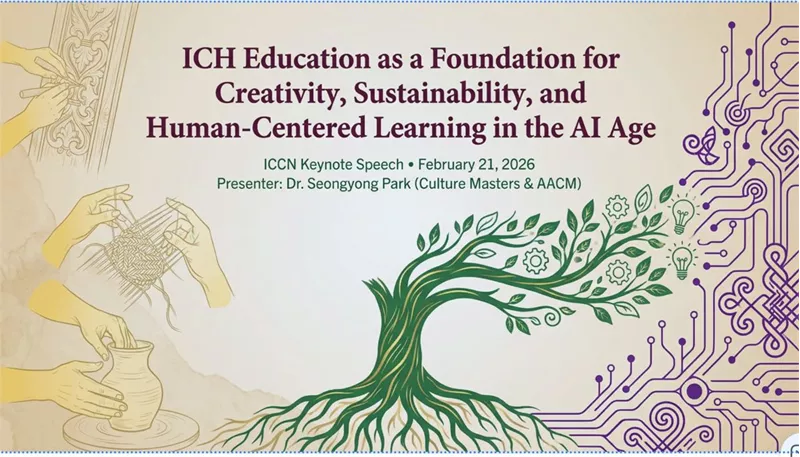
Rethinking Human-Centered Education in the Age of AI
Feb 22, 2026 Dr. SeongYong Park
Seongyong Park, Editor-in-Chief
As artificial intelligence (AI) rapidly reshapes education and society, the central question of future learning is no longer simply “What should we learn?” Rather, we must ask a deeper question: “What kind of human beings do we aspire to become?”
At the ICCN International Workshop in Bangalore, this concern was placed at the heart of contemporary educational discourse. The crisis in education today is not merely about technological gaps or efficiency, but a civilizational shift in which knowledge is becoming separated from wisdom.
AI grows faster and more sophisticated each day. Yet technological acceleration does not automatically lead to human growth. A technology-driven race risks reducing education to functional training and information processing, sidelining ethical reflection, communal responsibility, and the search for meaning.
“For whom, and toward what, is AI accelerating?”
While AI discourse emphasizes competitiveness, productivity, and data dominance, reflection on human dignity and cultural foundations remains limited. Efficiency has increased—but social trust and solidarity have weakened.
────────────────────────
Living Knowledge Beyond Technology
────────────────────────
The answer lies not in more advanced technology, but in the accumulated wisdom of humanity: Intangible Cultural Heritage (ICH).
ICH is not a relic of the past. It is a living knowledge system capable of restoring human-centered learning.
Korea’s fermentation culture integrates microbial science, ecological cycles, and communal cooperation. India’s traditional stepwells demonstrate sustainable infrastructure design for climate resilience. Mongolia’s nomadic pastoral knowledge models ecological balance, ethics, and shared responsibility.
AI can process data, but it cannot create meaning. It can recognize patterns, but it cannot generate trust. The direction of technology is ultimately shaped by human values and cultural judgment.
────────────────────────
The Void of a Speed-Driven Civilization
────────────────────────
The real issue is not technology itself, but acceleration without direction.
AI expansion is reshaping labor markets, deepening inequality, and weakening democratic deliberation. Cultural foundations—language, memory, shared values—are increasingly pressured by standardization and simplification.
Culture is the invisible infrastructure of society. Trust precedes efficiency. Ethics precede technology. Community precedes data. Without cultural sustainability, even the most advanced technology cannot sustain civilization.
────────────────────────
From Preservation to Educational Redesign
────────────────────────
Intangible cultural heritage must move from preservation to the center of educational transformation. Three strategic shifts are essential:
• Interdisciplinary integration connecting traditional knowledge with science and social studies
• Recognizing tradition bearers and artisans as key educational actors
• Expanding experiential and participatory learning ecosystems
“The greatest innovation challenge in the age of AI is not technology—but humanity.
True innovation lies in cultivating wisdom, responsibility, and social consciousness alongside digital skills.”
The true competitive advantage in the age of AI is not faster algorithms, but deeper humanity.